

How to Style a Fedora with a Scarf: 2026 Styling Guide
Posted by Editorial Team on
Table of Contents
- Why a Scarf and Fedora Is the Ultimate Accessory Pair
- Choosing the Right Scarf Material for Your Fedora
- How to Tie a Scarf Around a Hat Brim: Step-by-Step
- Color Coordination: Matching Your Scarf to Your Fedora
- Fedora Hat Etiquette for Business Casual Settings
- Best Fedora Hat Materials for Winter Styling
- Face Shape, Gender-Neutral Styling, and Fabric Care
- Frequently Asked Questions
Last Updated: September 10, 2026
Why a Scarf and Fedora Is the Ultimate Accessory Pair
The style fedora scarf combination works because it solves a problem most hats create: a fedora alone frames the face, but a scarf adds color, texture, and personality that a felt or straw hat can't deliver on its own. This pairing moves from runway styling to everyday wardrobes because it does two jobs at once, warming the neck while pulling an entire ensemble together.
Think of the hat as the anchor and the scarf as the accent. A neutral felt fedora lets a silk scarf carry the color story. A patterned scarf softens a stark black brim. This is the layering logic behind every strong winter accessories look, and it's why fashion editors return to it season after season.
Below, we'll walk through material selection, the two knots that work best, color coordination, and the care that keeps both pieces looking sharp for years. If you've ever felt a fedora "wasn't for you," this guide is built to change that.
Choosing the Right Scarf Material for Your Fedora
The best scarf material for a fedora depends on season and finish: silk for warm-weather polish, wool for winter warmth, and Tencel for a sustainable middle ground that drapes beautifully.
Silk, Wool, and Tencel: What Works Best
- Silk gives a smooth, luminous finish that pairs naturally with a structured felt hat. It's the choice for spring, early fall, and business casual settings.
- Wool delivers warmth and holds a knot firmly. A wool scarf in a plaid or herringbone pattern adds texture against a smooth brim.
- Tencel offers a soft, breathable drape with a lower environmental footprint, which matters to shoppers who want luxury without waste.
A common mistake is pairing a heavy, chunky knit with a delicate straw hat. The texture clash reads as accidental rather than intentional. Match weight to weight: light with light, substantial with substantial.
How to Tie a Scarf Around a Hat Brim: Step-by-Step
Tying a scarf around a hat brim takes about two minutes and requires only a folded scarf and two bobby pins (youtube.com). The goal is a secure wrap that follows the brim's curve without crushing the crown. What separates a wrap that survives a windy commute from one that slides off by lunch is friction: felt and straw both have a slick finish, so the scarf needs a mechanical anchor, not just a knot.
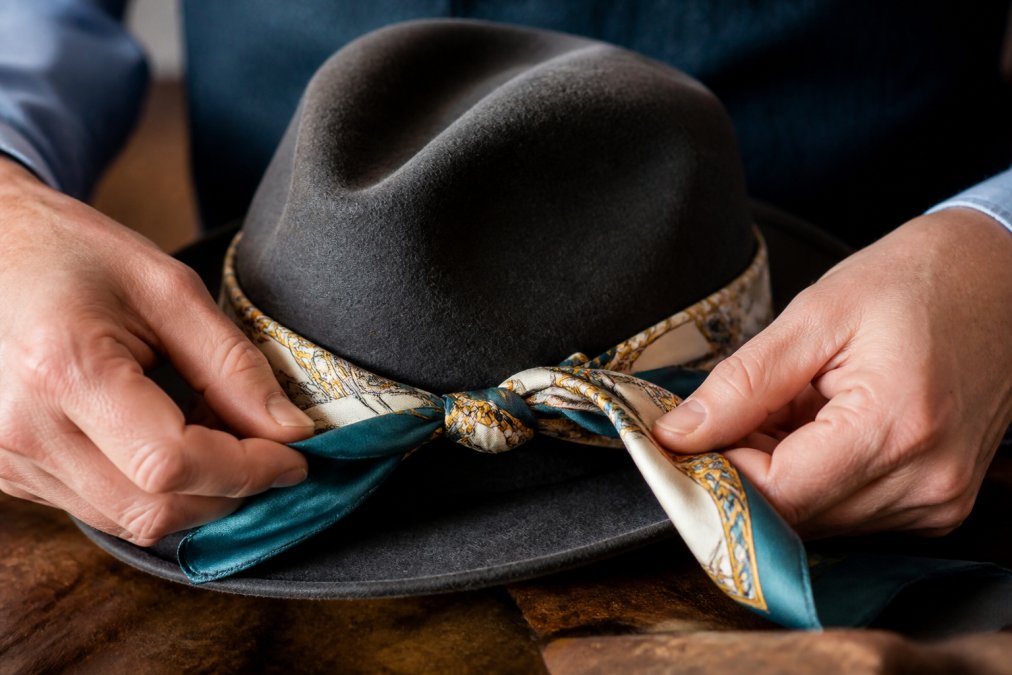
The Classic Hatband Wrap
- Fold your scarf lengthwise until it's roughly 2 inches wide. A 35-inch square silk scarf folds to about the right width; a longer rectangular scarf can be doubled (realsimple.com).
- Center the scarf at the back of the crown, just above the brim.
- Wrap both ends forward around the base of the crown, keeping the fabric flat rather than twisted so it lies against the felt.
- Cross the ends at the front and tie a single knot. Pull until the band is snug but not denting the crown.
- Tuck the loose ends under the band and secure with two bobby pins, angling each pin so it catches both the scarf and the inner hatband.
Expected result: a clean hatband that reads as part of the hat, not an afterthought.
The Low Chignon Headscarf Method
- Drape the scarf over your head so it covers the crown beneath the fedora.
- Gather both ends at the nape of your neck.
- Twist the ends together and coil them into a low chignon.
- Pin the coil in place with bobby pins.
- Set the fedora on top, tilting the brim slightly for balance.
This method suits cooler weather and adds volume at the back, which flatters longer face shapes.
Why Scarves Slip Off Felt and Straw (and How to Stop It)
Most guides skip this, and it's the reason a wrap that looks perfect in the mirror fails on the street. Felt has a brushed, slightly fuzzy surface that grips loosely woven wool but lets smooth silk slide. Straw is smoother still, so a silk scarf on a straw brim has almost no friction to work with.
Three fixes that work in practice:
- Match fabric to hat surface. Wool and cashmere scarves grip felt; silk and satin scarves need a straw or smooth-felt hat plus pins.
- Add a hidden anchor. A small piece of double-sided fashion tape between the scarf and the inner hatband stops creeping without visible hardware. Sew-in hook-and-loop strips are a more permanent option for a scarf you wear often.
- Pin through the band, not the felt. Bobby pins should catch the scarf and the hat's interior sweatband or ribbon, never pierce the outer felt, which leaves a permanent hole.
Troubleshooting Common Wrap Problems
- Knot looks lumpy: you twisted the fabric instead of folding it flat. Refold and rewrap.
- Band sits too high: it should rest at the base of the crown, just above where the brim meets the hat body, not on the brim itself.
- Ends won't stay tucked: use a longer scarf and tuck the tails under the band on opposite sides rather than the same side.
- Crown looks dented: you pulled the knot too tight. Loosen and re-tie with less tension.
A short video or animated GIF of the classic wrap is the fastest way to teach this, since the fold-and-cross motion is hard to follow in still images. If you're building this look for the first time, practice the wrap on the hat alone before adding it to a full outfit.
Color Coordination: Matching Your Scarf to Your Fedora
The simplest rule for color coordination is to pull one color from your outfit and repeat it in the scarf, then let the fedora stay neutral. A camel felt hat with a rust silk scarf over a cream trench coat is a classic look that never feels dated.
For a modern twist, try tonal dressing: a charcoal fedora with a slate wool scarf and a gray button-up shirt. The coordination feels deliberate without shouting. If you want contrast, choose a plaid scarf with one thread that echoes the hat's undertone.
| Fedora Tone | Best Scarf Palette | Occasion |
|---|---|---|
| Black felt | Ivory, burgundy, emerald | Evening, formal |
| Camel felt | Rust, cream, olive | Daytime, business casual |
| Gray felt | Slate, navy, soft pink | Office, travel |
| Straw | White, pastel, nautical blue | Summer, resort |
Fedora Hat Etiquette for Business Casual Settings
Fedora hat etiquette for business casual settings comes down to restraint: keep the brim moderate, the scarf tidy, and the colors within a professional palette. A structured felt hat in a neutral tone reads as intentional; an oversized brim with a loud print reads as costume.
In practice, this means pairing a mid-width brim with a silk or fine wool scarf in a subdued pattern. Skip feathers and pins at the office and save them for weekend styling. If you work in a corporate environment, a low chignon wrap keeps the silhouette clean and professional.
Best Fedora Hat Materials for Winter Styling
The best fedora hat materials for winter are wool felt and fur felt, both of which hold their shape in cold, damp conditions and pair naturally with heavier scarves. Wool felt offers warmth at a friendlier price point; fur felt resists moisture and keeps its finish longer (britannica.com).
Straw hats belong to summer. Wearing straw in winter looks out of season and offers no warmth. For cold-weather styling, match a wool felt fedora with a chunky wool scarf, or use a Tencel blend to style fedora scarf looks with a lighter feel.
Care matters here. Brush felt hats with a soft hat brush after each wear, and store them crown-down or on a stand. Wool scarves should be folded, not hung, to prevent stretching.
Face Shape, Gender-Neutral Styling, and Fabric Care
Face shape compatibility is the detail most styling guides skip, and it's the one that decides whether a fedora actually suits you. The scarf matters here too, because it changes the visual width at your neck and jaw, which shifts how the brim reads against your face. A wide scarf adds horizontal weight at the jawline; a narrow one keeps the silhouette vertical.
Finding the Right Fit for Your Face Shape
- Oval: nearly any brim width works; experiment freely. A medium brim with a slim scarf keeps proportions balanced.
- Round: choose a taller crown and tilt the brim for angles. A long, narrow scarf worn vertically draws the eye down and lengthens the face.
- Square: pick a curved or teardrop brim to soften lines. A soft, draped scarf with rounded folds balances a strong jaw.
- Heart-shaped: a medium brim with a fuller scarf balances the jaw. Keep the scarf volume at the neck rather than the crown.
- Long or oblong: a wider brim and a chunky, horizontally wrapped scarf add width and shorten the face visually.
The mechanism is simple: the brim sets the horizontal line at your forehead, and the scarf sets the horizontal line at your neck. When those two lines are close in width, the face reads balanced. When the scarf is much wider than the brim, the face looks narrow; when the brim is much wider, the face looks small.
Gender-Neutral Styling
Most fedora-and-scarf content is written for women, which leaves a real gap. The styling logic doesn't change by gender; it changes by proportion and wrap style. A black felt fedora with a charcoal wool scarf works across wardrobes. The differences are practical:
- Wrap height: a single loop or a simple drape reads more neutral than a chignon or a bow.
- Scarf width: a 12- to 14-inch wide scarf drapes cleanly on most frames; oversized blanket scarves overwhelm smaller builds.
- Color: neutrals, earth tones, and monochromes travel across styles; bright prints read more directional.
- Brim width: a 2- to 2.5-inch brim is the most versatile across face shapes and presentations.
Fabric Care That Keeps Both Pieces Sharp
Care is where most guides stop short, and it's the difference between a scarf that lasts a season and one that lasts a decade.
- Silk: spot-clean with a mild detergent and cool water. Hand-wash gently if needed, then roll in a towel to remove excess water and air-dry flat away from direct sun. Never wring silk.
- Wool and cashmere: hand-wash in cool water with a wool-safe detergent, then lay flat to dry. Folding, not hanging, prevents shoulder stretch. Store with cedar to deter moths.
- Tencel and blends: follow the care label; most tolerate a gentle machine cycle in a mesh bag, but air-drying preserves the drape.
- Felt hats: brush with a soft hat brush after each wear to lift dust, and store crown-down or on a stand to hold the shape. Avoid prolonged rain, which can spot felt.
- Straw hats: wipe with a damp cloth and store away from humidity, which can warp the weave.
Frequently Asked Questions
What are the etiquette rules for wearing a fedora hat?
Indoors, remove your fedora in homes, restaurants, and places of worship. In business casual offices, a fedora is acceptable in common areas but should come off at your desk. Tilt the brim slightly forward for a classic look. When greeting someone, a brief tip of the brim works. Never wear a fedora with athletic wear or at formal black-tie events. These guidelines keep your look polished and respectful.
Can you wear a scarf around the brim of a fedora?
Yes, wrapping a scarf around the hatband is one of the most popular ways to style a fedora with a scarf. A silk scarf works best for this because it lies flat against the felt without adding bulk. Fold the scarf into a narrow strip, wrap it around the base of the crown, and tuck or knot the ends at the back. This adds color and texture while keeping the hat's silhouette intact.
How do you tie a scarf to a fedora for a secure fit?
Start by folding a square silk scarf into a triangle, then roll it into a band about 2 inches wide. Place the center at the front of the hatband and wrap both ends around to the back. Cross the ends once and tie a small double knot. Tuck any loose fabric under the band. For extra security, use two bobby pins to anchor the knot to the hat's inner band. This method stays put through wind and daily wear.
Are fedoras in style in 2026?
Fedoras remain a strong style choice in 2026, especially when paired with scarves for a layered, editorial look. Runway shows and fashion magazines continue to feature felt and straw fedoras as statement accessories. The key is choosing a modern silhouette, such as a medium brim with a clean crown, and pairing it with quality materials. A well-styled fedora with a silk or wool scarf reads timeless rather than costume-like.
Share this post
- 0 comment
- Tags: best fedora hat materials for winter, fedora hat etiquette for business casual, how to style fedora with scarf, how to tie a scarf around a hat brim, style fedora scarf